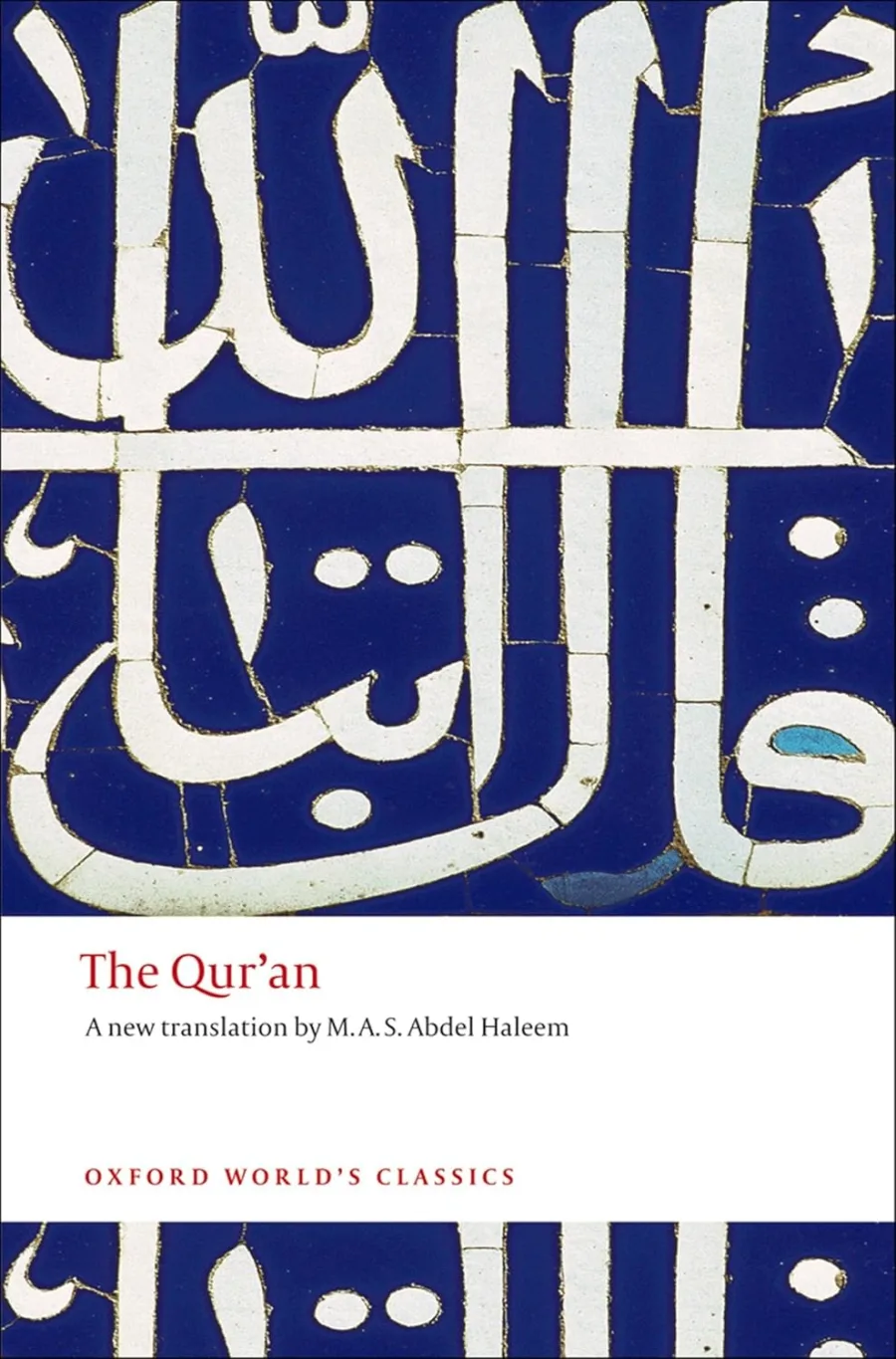
The Qur'an (Oxford World's Classics)
M.A.S. Abdel Haleem (Translator)
eBook
• English
• 9780191574078
No ratings yet
| Publisher | Oxford University Press |
|---|---|
| ISBN13 | 9780191574078 |
| ASIN/SKU | B001ODEPPI |
| Book Format | eBook |
| Language | English |
| Book Code | BD00069624 |
Buy this Book
Amazon Stores
Ebook Stores
Other Stores
Discover The Qur'an (Oxford World's Classics) by M.A.S. Abdel Haleem (Translator). This book is published by Oxford University Press in eBook format, ISBN 9780191574078, ASIN B001ODEPPI, under Religion and Spirituality, Quran, Islam.
Book Description
'Read! Your Lord is the Most Bountiful one who taught by the pen, who taught man what he did not know.
'The Qur'an, believed by Muslims to be the word of God, was revealed to the Prophet Muhammad 1400 years ago. It is the supreme authority in Islam and the living source of all Islamic teaching; it is a sacred text and a book of guidance, that sets out the creed, rituals, ethics, and laws of the Islamic religion. It has been one of the most influential books in the history of literature. Recognized as the greatest literary masterpiece in Arabic, it has nevertheless remained difficult to understand in its English translations. This new translation is written in a contemporary idiom that remains faithful to the original, making it easy to read while retaining its powers of eloquence. Archaisms and cryptic language are avoided, and the Arabic meaning preserved by respecting the context of the discourse.
The message of the Qur'an was directly addressed to all people regardless of class, gender, or age, and this translation is equally accessible to everyone. ABOUT THE SERIES: For over 100 years Oxford World's Classics has made available the widest range of literature from around the globe. Each affordable volume reflects Oxford's commitment to scholarship, providing the most accurate text plus a wealth of other valuable features, including expert introductions by leading authorities, helpful notes to clarify the text, up-to-date bibliographies for further study, and much more.
'The Qur'an, believed by Muslims to be the word of God, was revealed to the Prophet Muhammad 1400 years ago. It is the supreme authority in Islam and the living source of all Islamic teaching; it is a sacred text and a book of guidance, that sets out the creed, rituals, ethics, and laws of the Islamic religion. It has been one of the most influential books in the history of literature. Recognized as the greatest literary masterpiece in Arabic, it has nevertheless remained difficult to understand in its English translations. This new translation is written in a contemporary idiom that remains faithful to the original, making it easy to read while retaining its powers of eloquence. Archaisms and cryptic language are avoided, and the Arabic meaning preserved by respecting the context of the discourse.
The message of the Qur'an was directly addressed to all people regardless of class, gender, or age, and this translation is equally accessible to everyone. ABOUT THE SERIES: For over 100 years Oxford World's Classics has made available the widest range of literature from around the globe. Each affordable volume reflects Oxford's commitment to scholarship, providing the most accurate text plus a wealth of other valuable features, including expert introductions by leading authorities, helpful notes to clarify the text, up-to-date bibliographies for further study, and much more.
Author Biography
M. A. S. Abdel Haleem was born in Egypt, and learned the Qur'an by heart from childhood. Educated at al-Azhar, Cairo, and Cambridge Universities, he has taught Arabic and Islamic Studies at Cambridge and London Universities since 1966, including courses in advanced translation and the Qur'an. He is now Professor of Islamic Studies at the School of Oriental and African Studies, University of London. He is also working on An Introduction to the Qur'an and English Translation London Qur'an Studies series.
Editorial Reviews
Editorial Reviews will be added soon…
Book Summary
The Quran is the central religious text of Islam, believed by Muslims to be a revelation from God (Allah). Unlike a traditional narrative book that moves strictly from beginning to end with a plot and characters, the Quran is a compilation of divine messages, exhortations, laws, and moral principles. To understand the Quran is to understand the foundation of Islamic theology, law, and the worldview of over nearly two billion Muslims today.
Revealed in classical Arabic to Prophet Muhammad through the Angel Gabriel over a period of 23 years (from 610 to 632 CE), the book is divided into 114 chapters, known as Surahs. These Surahs are loosely organized by length—from the longest at the beginning to the shortest at the end—rather than chronologically. The revelations are broadly categorized into two distinct periods: the Meccan Surahs, which focus heavily on faith, the afterlife, and the oneness of God; and the Medinan Surahs, which were revealed after the early Muslim community migrated to Medina, focusing more on laws, societal structure, and community governance.
To summarize the Quran requires looking at its core thematic pillars rather than a linear plotline.
1. Tawhid: The Absolute Oneness of God
The most foundational and heavily emphasized theme in the Quran is Tawhid—the absolute, indivisible oneness of God. The Quran repeatedly asserts that God is the sole creator, sustainer, and sovereign of the universe. He is described as omnipotent, omniscient, and entirely unique, transcending human comprehension.
Surah Al-Ikhlas (Chapter 112) succinctly captures this principle: "Say, 'He is Allah, [who is] One, Allah, the Eternal Refuge. He neither begets nor is born, nor is there to Him any equivalent.'"
The text vigorously rejects polytheism (associating partners with God, known as shirk) and distances itself from the Christian concept of the Trinity. Throughout the Quran, God’s mercy and compassion are also heavily emphasized. Every chapter except one begins with the phrase Bismillah ir-Rahman ir-Rahim ("In the name of God, the Most Gracious, the Most Merciful").
2. Risalah: Prophethood and the Chain of Revelation
The Quran does not present Islam as a new religion, but rather as the culmination and restoration of the original monotheistic faith revealed since the dawn of humanity. It outlines the concept of Risalah (Prophethood), asserting that God has continuously sent messengers to every nation to guide them back to the worship of the One God.
Many figures familiar to the Judeo-Christian tradition feature prominently in the Quran, including Adam, Noah, Abraham (Ibrahim), Moses (Musa), and Jesus (Isa). Moses is actually the most frequently mentioned prophet by name. The Quran acknowledges previous divine scriptures—such as the Torah, the Psalms, and the Gospel—but maintains that over time, human alteration and misinterpretation corrupted these original messages. The Quran is therefore presented as the final, uncorrupted revelation, and Muhammad is declared the "Seal of the Prophets," meaning he is the final messenger sent to humanity.
3. Akhirah: The Afterlife and Divine Judgment
A massive portion of the Quran is dedicated to the concept of Akhirah (the Hereafter). The text asserts that worldly life is merely a temporary test, a fleeting phase preparing the soul for eternal existence. It vividly describes the Day of Judgment, a time when the universe as we know it will be unmade, all the dead will be resurrected, and every individual will stand before God to be held accountable for their earthly deeds.
The imagery used for the afterlife is striking. Those who believed in God and lived righteously are promised Jannah (Paradise), described as a lush, tranquil garden with flowing rivers, eternal peace, and proximity to the Divine. Conversely, those who rejected God, oppressed others, and lived in arrogance are warned of Jahannam (Hellfire), depicted as a place of intense physical and spiritual suffering. This constant reminder of ultimate accountability serves as the primary moral motivator within the Quranic worldview.
4. Moral, Ethical, and Social Guidance
Beyond theology, the Quran is a comprehensive guidebook for human behavior. It sets down a robust ethical framework built on justice, compassion, honesty, and humility. The text repeatedly pairs the concept of believing in God with doing good deeds (amal salih).
The Quran places a tremendous emphasis on social welfare. It mandates the payment of Zakat (obligatory charity) as a means to purify wealth and redistribute it to the needy. It fiercely advocates for the rights of the most vulnerable members of society—specifically orphans, widows, the poor, and travelers. Oppression, arrogance, hoarding wealth, usury (charging exploitative interest), and cheating in business are heavily condemned.
5. Legal Framework and Community Governance
In the later Medinan chapters, the Quran lays down foundational laws for the new, expanding Muslim community. It provides regulations on marriage, divorce, inheritance, and dietary restrictions (such as the prohibition of pork and alcohol). It outlines laws regarding criminal justice, setting terms for retaliation and forgiveness, though it frequently states that forgiveness is the spiritually superior choice.
It also addresses the ethics of conflict. The Quran permits fighting in self-defense against oppression and persecution, establishing rules of engagement that forbid the killing of non-combatants or the destruction of property. It strictly states, "There is no compulsion in religion" (2:256), establishing the principle that faith must be a matter of free will and inner conviction.
6. The Natural World and Human Intellect
The Quran frequently appeals to human intellect and reason. It repeatedly commands the reader to observe the natural world—the orbit of the celestial bodies, the cycle of rain, the development of the human embryo in the womb, and the diversity of nature—as "signs" (ayat) of God’s intelligent design and mercy. The text does not see a division between the pursuit of knowledge and religious faith; rather, studying the natural world is presented as a pathway to recognizing the Creator.
Literary Style and Preservation
The Quran is highly revered for its linguistic beauty. Written in a unique style that falls somewhere between poetry and prose—known as rhymed prose (saj' )—it utilizes powerful rhythm, phonetic harmony, and deep rhetorical devices. In Islamic theology, the sheer linguistic perfection of the Quran is considered its primary miracle, proving its divine origin, as the Prophet Muhammad was known to be unlettered (unable to read or write).
Because the text was revealed orally, it was memorized by early Muslims before being compiled into a standardized written book shortly after the Prophet's death under the Caliph Uthman. To this day, millions of Muslims worldwide memorize the entire book in Arabic, earning the title of Hafiz, ensuring its preservation in the exact phonetic state in which it was revealed.
Conclusion
In summary, the Quran is an expansive, multifaceted text that serves as a theological anchor, a moral compass, and a legal blueprint. It is a book deeply concerned with the nature of the Creator and the purpose of the creation. By demanding absolute monotheism, reminding humanity of the inevitability of divine judgment, and laying out strict ethical guidelines prioritizing justice and compassion, the Quran offers a complete system of living. For the believer, it is not merely a book to be read, but the literal, direct speech of God meant to be recited, pondered, and embodied in daily life.
Revealed in classical Arabic to Prophet Muhammad through the Angel Gabriel over a period of 23 years (from 610 to 632 CE), the book is divided into 114 chapters, known as Surahs. These Surahs are loosely organized by length—from the longest at the beginning to the shortest at the end—rather than chronologically. The revelations are broadly categorized into two distinct periods: the Meccan Surahs, which focus heavily on faith, the afterlife, and the oneness of God; and the Medinan Surahs, which were revealed after the early Muslim community migrated to Medina, focusing more on laws, societal structure, and community governance.
To summarize the Quran requires looking at its core thematic pillars rather than a linear plotline.
1. Tawhid: The Absolute Oneness of God
The most foundational and heavily emphasized theme in the Quran is Tawhid—the absolute, indivisible oneness of God. The Quran repeatedly asserts that God is the sole creator, sustainer, and sovereign of the universe. He is described as omnipotent, omniscient, and entirely unique, transcending human comprehension.
Surah Al-Ikhlas (Chapter 112) succinctly captures this principle: "Say, 'He is Allah, [who is] One, Allah, the Eternal Refuge. He neither begets nor is born, nor is there to Him any equivalent.'"
The text vigorously rejects polytheism (associating partners with God, known as shirk) and distances itself from the Christian concept of the Trinity. Throughout the Quran, God’s mercy and compassion are also heavily emphasized. Every chapter except one begins with the phrase Bismillah ir-Rahman ir-Rahim ("In the name of God, the Most Gracious, the Most Merciful").
2. Risalah: Prophethood and the Chain of Revelation
The Quran does not present Islam as a new religion, but rather as the culmination and restoration of the original monotheistic faith revealed since the dawn of humanity. It outlines the concept of Risalah (Prophethood), asserting that God has continuously sent messengers to every nation to guide them back to the worship of the One God.
Many figures familiar to the Judeo-Christian tradition feature prominently in the Quran, including Adam, Noah, Abraham (Ibrahim), Moses (Musa), and Jesus (Isa). Moses is actually the most frequently mentioned prophet by name. The Quran acknowledges previous divine scriptures—such as the Torah, the Psalms, and the Gospel—but maintains that over time, human alteration and misinterpretation corrupted these original messages. The Quran is therefore presented as the final, uncorrupted revelation, and Muhammad is declared the "Seal of the Prophets," meaning he is the final messenger sent to humanity.
3. Akhirah: The Afterlife and Divine Judgment
A massive portion of the Quran is dedicated to the concept of Akhirah (the Hereafter). The text asserts that worldly life is merely a temporary test, a fleeting phase preparing the soul for eternal existence. It vividly describes the Day of Judgment, a time when the universe as we know it will be unmade, all the dead will be resurrected, and every individual will stand before God to be held accountable for their earthly deeds.
The imagery used for the afterlife is striking. Those who believed in God and lived righteously are promised Jannah (Paradise), described as a lush, tranquil garden with flowing rivers, eternal peace, and proximity to the Divine. Conversely, those who rejected God, oppressed others, and lived in arrogance are warned of Jahannam (Hellfire), depicted as a place of intense physical and spiritual suffering. This constant reminder of ultimate accountability serves as the primary moral motivator within the Quranic worldview.
4. Moral, Ethical, and Social Guidance
Beyond theology, the Quran is a comprehensive guidebook for human behavior. It sets down a robust ethical framework built on justice, compassion, honesty, and humility. The text repeatedly pairs the concept of believing in God with doing good deeds (amal salih).
The Quran places a tremendous emphasis on social welfare. It mandates the payment of Zakat (obligatory charity) as a means to purify wealth and redistribute it to the needy. It fiercely advocates for the rights of the most vulnerable members of society—specifically orphans, widows, the poor, and travelers. Oppression, arrogance, hoarding wealth, usury (charging exploitative interest), and cheating in business are heavily condemned.
5. Legal Framework and Community Governance
In the later Medinan chapters, the Quran lays down foundational laws for the new, expanding Muslim community. It provides regulations on marriage, divorce, inheritance, and dietary restrictions (such as the prohibition of pork and alcohol). It outlines laws regarding criminal justice, setting terms for retaliation and forgiveness, though it frequently states that forgiveness is the spiritually superior choice.
It also addresses the ethics of conflict. The Quran permits fighting in self-defense against oppression and persecution, establishing rules of engagement that forbid the killing of non-combatants or the destruction of property. It strictly states, "There is no compulsion in religion" (2:256), establishing the principle that faith must be a matter of free will and inner conviction.
6. The Natural World and Human Intellect
The Quran frequently appeals to human intellect and reason. It repeatedly commands the reader to observe the natural world—the orbit of the celestial bodies, the cycle of rain, the development of the human embryo in the womb, and the diversity of nature—as "signs" (ayat) of God’s intelligent design and mercy. The text does not see a division between the pursuit of knowledge and religious faith; rather, studying the natural world is presented as a pathway to recognizing the Creator.
Literary Style and Preservation
The Quran is highly revered for its linguistic beauty. Written in a unique style that falls somewhere between poetry and prose—known as rhymed prose (saj' )—it utilizes powerful rhythm, phonetic harmony, and deep rhetorical devices. In Islamic theology, the sheer linguistic perfection of the Quran is considered its primary miracle, proving its divine origin, as the Prophet Muhammad was known to be unlettered (unable to read or write).
Because the text was revealed orally, it was memorized by early Muslims before being compiled into a standardized written book shortly after the Prophet's death under the Caliph Uthman. To this day, millions of Muslims worldwide memorize the entire book in Arabic, earning the title of Hafiz, ensuring its preservation in the exact phonetic state in which it was revealed.
Conclusion
In summary, the Quran is an expansive, multifaceted text that serves as a theological anchor, a moral compass, and a legal blueprint. It is a book deeply concerned with the nature of the Creator and the purpose of the creation. By demanding absolute monotheism, reminding humanity of the inevitability of divine judgment, and laying out strict ethical guidelines prioritizing justice and compassion, the Quran offers a complete system of living. For the believer, it is not merely a book to be read, but the literal, direct speech of God meant to be recited, pondered, and embodied in daily life.
Sample Chapters
Sample Chapters will be added soon…
Reader Reviews
No reviews yet.
The Qur'an (Oxford World's Classics)
Download Cover Image
Do you want to download the full cover image for The Qur'an (Oxford World's Classics)?